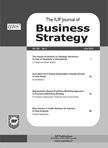
The Impact of Intuition on Strategic Decisions:
A Case of Hospitals in Uttarakhand
--S P Singh and Himani Singhal
The purpose of this study was to assess the impact of intuition on strategic decisions in the context of hospitals. A sample of 412 doctors, having their own hospitals/nursing homes practicing in Uttarakhand, India, was taken using random sampling technique. The results indicated that there was a significant impact of intuition on strategic decisions. Faith in intuition, emotional awareness, and knowledge-based experience were found to have significant impact on strategic decisions while following stability strategy. Curiosity, emotional awareness, self-questioning, knowledge-based experience were found to have significant impact on adopting expansion strategy. Curiosity, emotional awareness, inadequate information were found to have significant impact on implementing retrenchment strategy. The study also found that curiosity, faith in intuition, emotional awareness, self-questioning, inadequate information and knowledgebased experience contributed significantly for entrepreneurial strategic decision.
© 2016 IUP. All Rights Reserved.
Innovation for Creating Sustainable Lifestyle Brands: A Case Study
--Kunal Mankodi
The Indian consumer has evolved since 1991 when multinationals entered India, offering products and services which were not available earlier. He now has a large number of options to choose from and globalization has aided the cultural movement due to which the western lifestyles, products and services are demanded by a typical upper middle-class young consumer. He looks beyond product utility to seek intangibles like style statement associated with the product. But can a service become a lifestyle statement? Can companies think of sustainable innovative business models? The paper attempts to answer these questions with the example of an Indian Company called Kaya Skin Clinic, a leading lifestyle brand in the professional skin care segment. The aim of the paper is to develop a conceptual model and illustrate with example the role and relevance of innovation in creating niche, urbane and yet sustainable business. Kaya Skin Clinic has been able to create a whole new market segment of scientific approach-driven skin care solutions. What was once a supplementary service offered by traditional beauty salons, has now become a thriving business model. Armed with a robust proprietary Information and Technology (IT) architecture that facilitates Customer Relationship Management (CRM), Loyalty and Referral Marketing (LRM), Kaya has created a lifestyle brand from what was once a basic service. Here, lifestyle brands create a certain degree of style statement for consumers. The case study shows that developing innovative business model by industry convergence, backed by creation of entry barriers, can give sustainable competitive advantage to firms and develop consumer lifestyles.
© 2016 IUP. All Rights Reserved.
Segmentation-Based Predictive Modeling Approach
in Insurance Marketing Strategy
--P H A Desik, B Samarendra, Prashanth Soma and N Sundari
Insurance markets have changed radically and deeply in the past 20 years. Deregulation, globalization of insurance institutions, intensified competition, electronic commerce, bancassurance and the emergence of new risks are among the challenges faced by insurance markets. This is forcing the insurers and financial houses to rethink their marketing strategy, moving from traditional brand-based strategy to Customer Equity (CE) (Blattberg et al., 2001). The paper discusses the importance of CE as a marketing strategy, and an attempt is made to demonstrate the impact of advanced analytics on CE strategy through crosssell by targeting the right customers with the right products. This attempt is a deviation from traditional segmentation approach. It has been proved beyond doubt that advanced analytics can help insurers in strategizing and creating profitable target base using analytics approaches. The paper attempts to develop models, product group-wise, to capture the aforesaid differences and apply the patterns learned from one product group on other product groups to maximize the chances of cross-sell. The value analysis showed substantial cost saving through preferred product suggestions per customer.
© 2016 IUP. All Rights Reserved.
Blue Oceans in Indian Sesame Oil Industry: A Case Analysis
--Revathy Rajasekaran
The paper highlights the importance of the Blue Ocean Strategy (BOS) in the era of cut-throat competition among companies. 25 years ago, the Indian government through its policy of liberalization and globalization paved the way for foreign companies to enter Indian market which imposed the challenge of increased competition. Today, the Indian companies face universal competition on the one hand, and a pressure to offer a wide range of products at economical price, on the other. This has resulted in decreasing profitable growth and companies are driven to compete primarily on cost. But only cost negotiation is not sufficient to outstay and compete in the global marketplace. It is time for companies to look into value innovation by adopting new marketing concepts like BOS. In this paper, the author analyzes the BOS in the Indian branded sesame oil industry.
© 2016 IUP. All Rights Reserved.
|